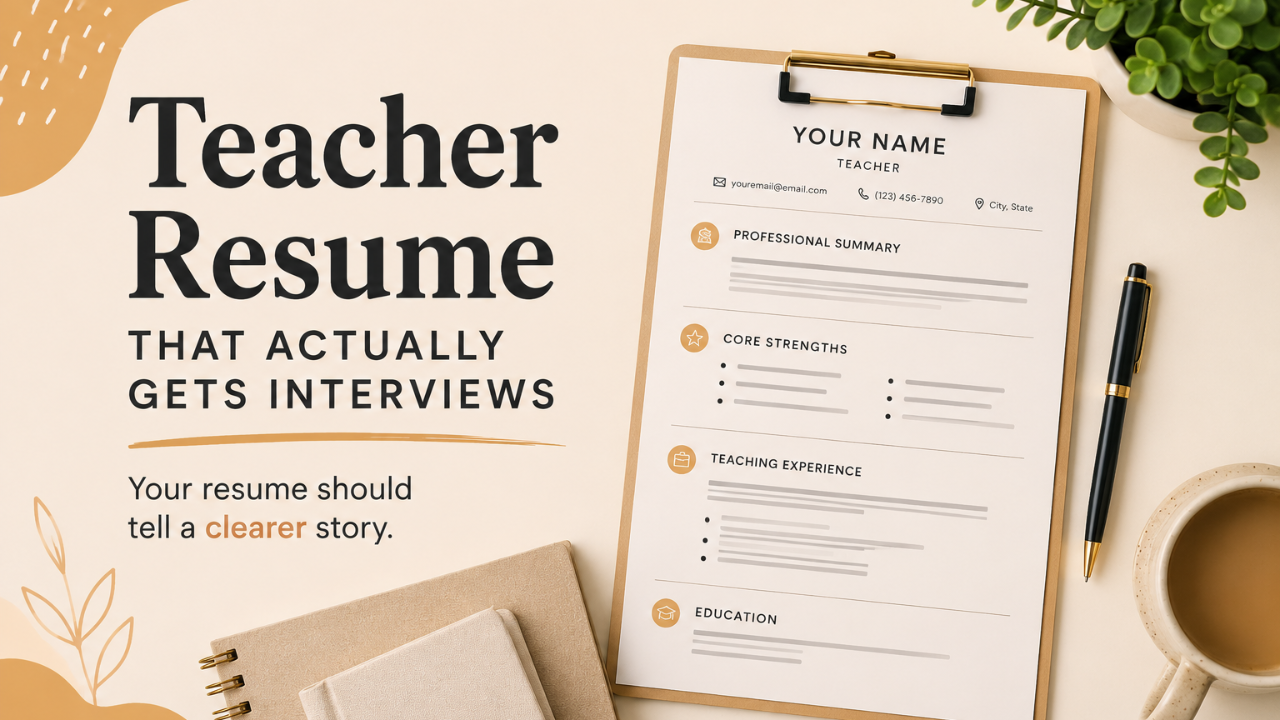
Teacher Resume That Actually Gets Interviews
A stronger resume does not mean adding more.
More bullet points.
More responsibilities.
More details.
It’s tempting to open a template and start packing in everything you’ve done over the last several years.
The problem is hiring managers are not sitting there hoping for the longest possible document.
They're trying to quickly figure out:
- what kind of teacher you are
- what strengths consistently show up in your work
- whether your experience aligns with the environment they're hiring for
A strong teacher resume is not a biography. It's evidence of your hiring story.
Why most teacher resumes blur together
A lot of teacher resumes unintentionally turn into task lists.
Things like:
- differentiated instruction
- classroom management
- collaboration
- lesson planning
- data analysis
These things aren't bad. They're all part of teaching.
But when every bullet point sounds broad and interchangeable, it becomes difficult to tell what actually makes one teacher different from another.
That's where resumes start to blur together.
Most teacher resumes explain what a teacher was responsible for.
But strong resumes reveal how a teacher operates.
That's the difference.
Your resume should reinforce a clear story
If you read my last post about hiring stories, this is where everything starts connecting.
Your resume should reinforce the same patterns over and over again.
For example...
If your hiring story is rooted in:
- strong systems
- relationship-building
- creativity
- collaboration
- adaptability
- intervention support
- structured communication
...your resume bullets should consistently reflect those themes.
Hiring managers are looking for patterns, so it doesn't help your case if you're randomly shifting every few lines. Without trying, you end up sounding like a completely different teacher from one bullet point to the next.
Patterns create clarity and clarity feels competent.
What I noticed as a hiring manager
When I hired teachers in a virtual school environment, I honestly wasn't spending too much time in the bullet point weeds.
There just wasn't enough time for that.
I was trying to understand how the teacher candidate worked.
Could they communicate clearly?
Could they manage systems independently?
Could they adapt easily?
Could they build trust with students and families in a virtual environment?
The strongest resumes made those answers obvious.
It wasn't about using fancy language. It was about using examples that consistently reinforced the same strengths.
Weaker resumes often try to include everything possible:
- every responsibility
- every committee
- every platform
- every buzzword
Ironically, this is what makes the teacher feel less clear, not more impressive.
Strong teacher resume bullets do this instead
Weak bullet:
- Responsible for lesson planning and classroom management
That doesn't really tell me anything about how the teacher operates.
Stronger bullet:
- Built structured small-group intervention systems that improved student participation and reduced off-task behavior during support blocks.
Now I can actually picture the teacher's approach.
Notice the difference?
One lists responsibilities, which are pretty generic to all teachers.
The other demonstrates a pattern.
That's what stronger resumes do repeatedly.
Weak bullet:
-
Used data to inform instruction.
Stronger bullet:
-
Used weekly assessment data to regroup students for targeted small-group instruction and adjust reteaching plans.
Weak bullet:
-
Communicated with families regularly.
Stronger bullet:
-
Created a consistent family communication routine that kept parents informed about student progress, missing work, and next steps.
Weak bullet:
-
Collaborated with team members.
Stronger bullet:
-
Partnered with grade-level teammates to align lesson pacing, share intervention strategies, and create consistent expectations across classrooms.
Remember, the point is not to make every bullet sound fancy. It's to show the work clearly enough that someone can understand how you think, lead, and solve problems.
A strong bullet usually answers at least one of these:
What did you build?
What did you improve?
What did you make easier?
What pattern does this prove about you?
That’s how your resume starts sounding less like a job description and more like evidence.
Your resume is not supposed to appeal to everyone
This is where teachers get themselves stuck.
They try to create the "perfect" resume that could work for absolutely any teaching role.
But the strongest resumes are usually more specific than that.
They make it easier for aligned schools to recognize "This teacher makes sense here."
That's the goal.
Not maximum appeal.
Maximum alignment.
When your resume tells a clearer story, it becomes easier to write the cover letter, choose portfolio pieces, and prepare interview examples because you’re no longer inventing a new version of yourself for every step. You’re reinforcing the same case in different ways.
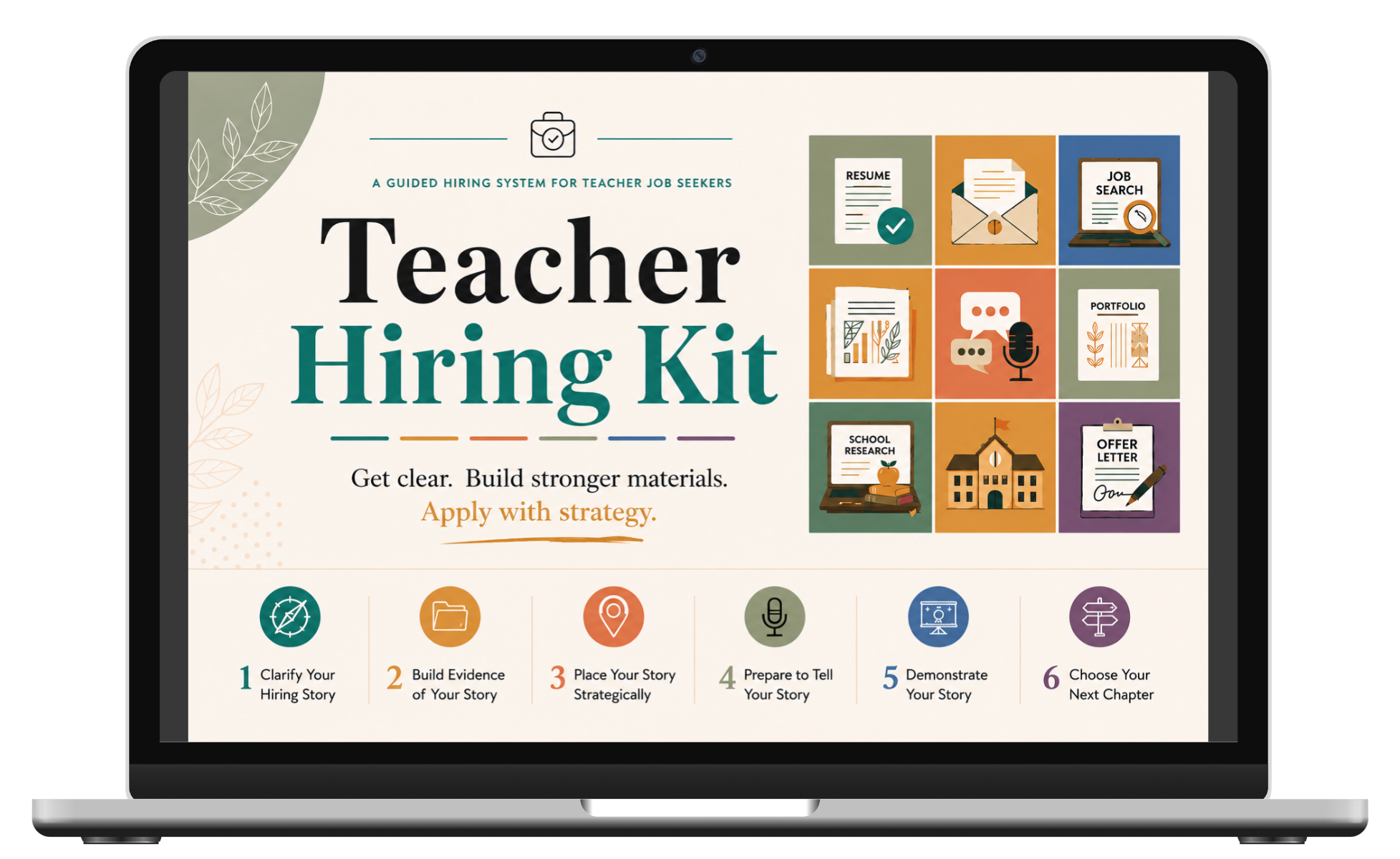
Inside the Teacher Hiring Kit, I walk teachers through how to build resumes, cover letters, portfolios, interview answers, and demo lesson strategies that all reinforce the same hiring story.
Strong hiring materials shouldn't feel like disconnected pieces.
They should work together to make your fit obvious.
Ready to build your hiring story before you keep rewriting your resume?
👉Check Out the Teacher Hiring Kit
Rethink How You're Doing This Whole Teaching Thing
I create content to help you think like a classroom CEO, not just a teacher.
From job search strategy to classroom systems to experience design, this is where it all starts to click.
No spam. No sharing your info. Just real support in your corner.