What Teaching Jobs Should You Actually Apply For?
Most teachers spend the first part of their job search obsessing over their resume.
They either apply to anything that looks remotely possible or talk themselves into roles that don’t actually fit because the market feels tight.
I get it, I've been there and done the exact same thing. When you need a job, that's the most obvious thing to do, right?
As much as it pains me to admit though, what this approach actually does is scatter your effort so thin that nothing lands.
If your job search feels messy, it might not be because you're unqualified. It just may be that you haven't spent enough time deciding what actually fits.
Not all teaching jobs are a fit (even if you can do them)
When we're on the job hunt and circumstances feel dire, it's natural to subscribe to the assumption that if you're certified, experienced and capable then you should be able to make most roles work.
That's technically true.
But it's also why people end up in jobs that drain them by October.
A teaching job isn't just a subject and a grade level. It's a full operating environment.
Same role on paper can look completely different depending on:
- how structured the school is
- how behavior is handled
- how much autonomy you actually have
- how decisions get made
When you're navigating the market, you're not just choosing a job. You're choosing the conditions you'll be working inside of every day.
Why your job search feels scattered
When you don’t have a clear filter, every role becomes a “maybe.”
And once every role is a maybe, your materials start shifting all over the place.
For one job, you’re trying to sound highly structured.
For another, flexible and creative.
For another, data-driven.
For another, warm and relationship-centered.
None of those are bad. Most teachers are a blend of all of them.
But when you keep reshaping yourself around every posting, your hiring story gets blurry.
That’s when you find yourself:
- tweaking your resume for every role
- rewriting your cover letter from scratch
- pulling random examples for interviews
- applying, waiting, refreshing, repeating
It feels productive because you’re doing a lot. But a lot of effort without a clear direction is just expensive chaos.
The goal isn't to become a different candidate for every school. It's to know what kind of role makes the strongest case for the teacher you already are.
The shift: stop asking "Can I do this?"
Most teachers can do a lot of jobs.That's not what makes you stand out.
The better question is: Is this the kind of environment I do my best work in?
That's where your search starts to narrow in a useful way.
I saw the implications of this firsthand as a hiring manager at a virtual school.
I'll admit, if I looked at a resume at all it was only a glance. As long as a teacher had the right credentials, I knew theoretically they could do the job.
But the more important question for me as their potential manager was "Can they do the job in this environment?"
And this is the question that should be on the teacher's mind, too.
Because when a teacher walks into an interview, they should be selling why they're a good fit for the role they're applying for, and that fit has everything to do with the environment, not just the job title.
If a teacher is out of touch with this positioning, it weakens them as a candidate.
3 questions to ask before you apply anywhere
You don't need extensive personality work to determine what your best fit is. You just need a quick filter you can actually use.
Before you apply, pause and ask:
1. What kind of structure does this role assume?
Am I walking into something established, or building from scratch?
2. What kind of support is actually present?
Not what’s promised. What’s visible in the posting, the language, the expectations?
3. What kind of teacher does this environment reward?
Collaborative? Independent? Highly structured? Flexible?
You can usually read this between the lines if you slow down enough to look.
If you skip this step, you end up adapting yourself to every job instead of finding one that already fits.
Teacher job search strategy (that actually works)
Instead of applying broadly (i.e. the spray and pray approach), narrow your search with intention.
That doesn't mean you have to limit your chances. It just means you need to increase your relevance.
When you focus your search:
- your resume starts telling a consistent story
- your examples don’t feel random
- your interviews feel more grounded because you actually want the role
You stop trying to be everything and start showing up as someone specific.
That’s what hiring teams remember.
How to narrow your job search fast
If you're juggling options right now, here's the simplest way to cut through:
Pick 2-3 non-negotiables
I'm not talking about a wishlist. Every teacher wants more $$$. I'm talking about non-negotiables.
Things like:
- level of support you need
- type of classroom environment you thrive in
- amount of structure vs autonomy
Then use those to eliminate roles. If a job doesn't meet those, it's out.
That one move alone will cut your mental overload in half when it comes to the job search.
What changes when you do this
You don't need 50 applications. You need a smaller number of aligned ones.
Ones that your hiring story can reflect. Ones that you can follow up on and build connections to.
When a role actually fits:
- your materials sharpen naturally
- your answers sound more like you
- your confidence isn’t forced
That's when you stop competing on volume and compete, instead, on clarity,
Before you polish another resume bullet, build your filter first.
Your resume should not be trying to make you look like a fit for every school. It should make the right schools recognize why you make sense for them.
That’s the first step in building a stronger hiring story.
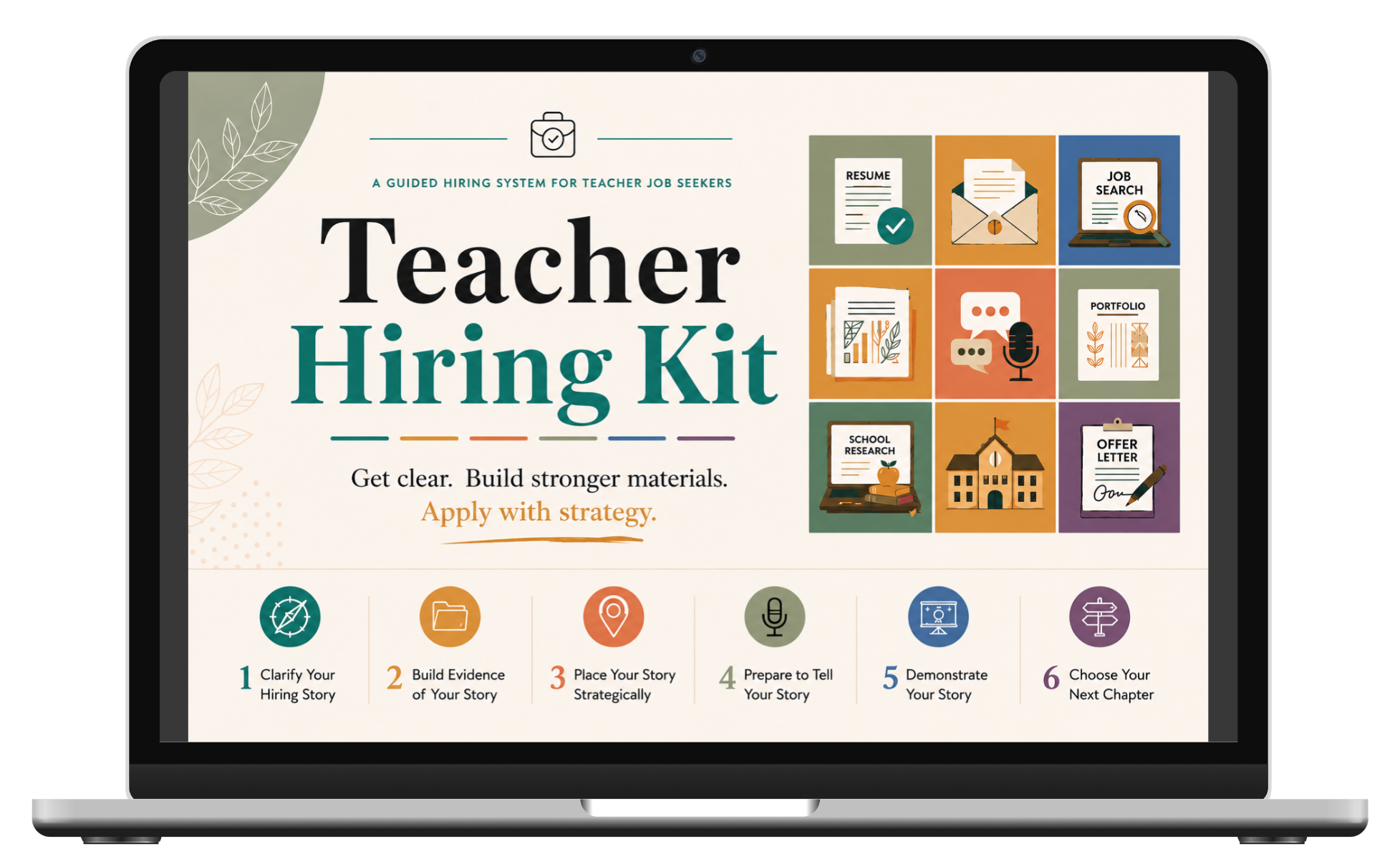
Inside the Teacher Hiring Kit, this is exactly where we start: clarifying your fit before you build your resume, cover letter, portfolio, interview answers, and demo lesson prep.
👉Check Out the Teacher Hiring Kit
Rethink How You're Doing This Whole Teaching Thing
I create content to help you think like a classroom CEO, not just a teacher.
From job search strategy to classroom systems to experience design, this is where it all starts to click.
No spam. No sharing your info. Just real support in your corner.